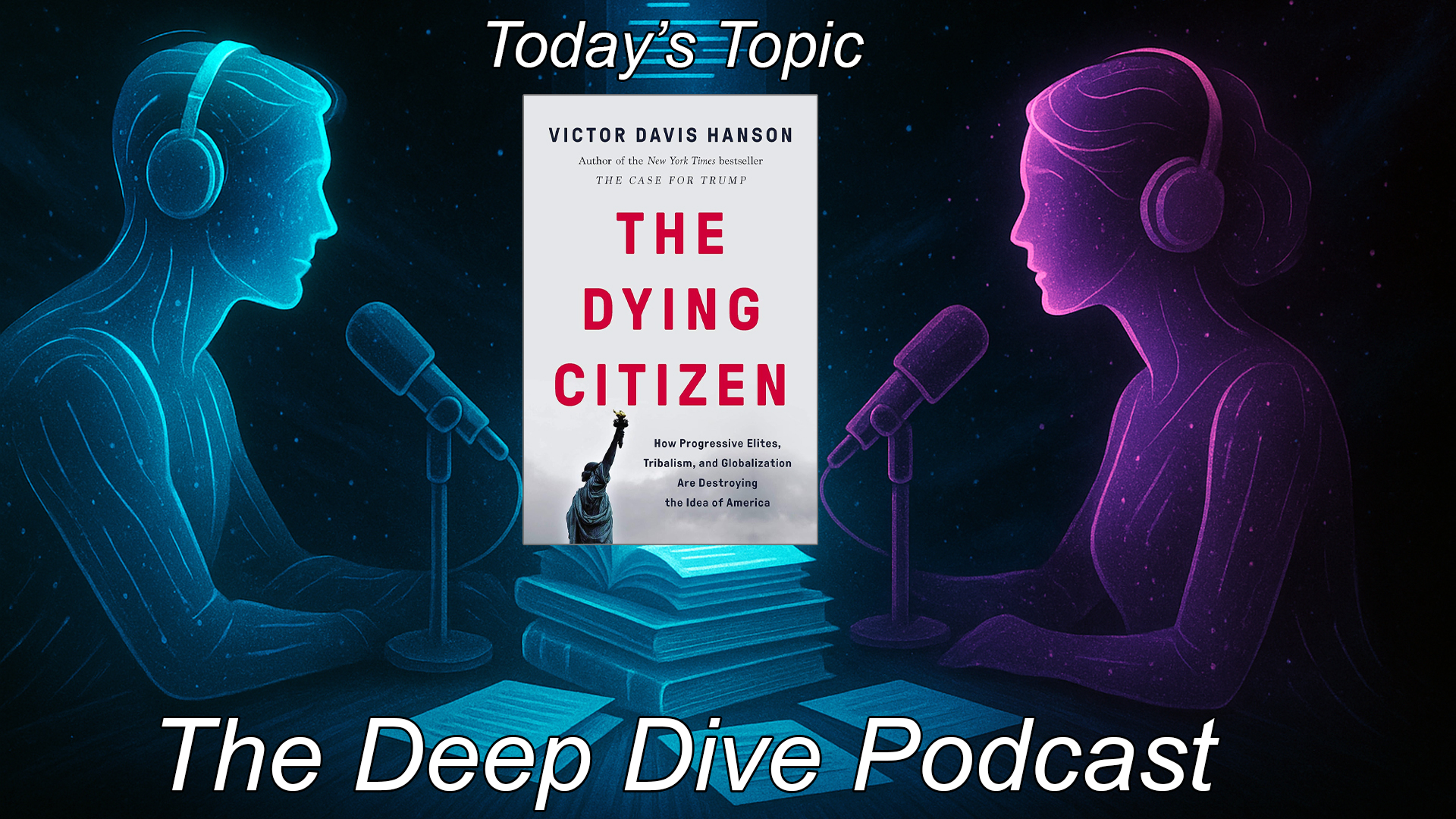
The Dying Citizen: How the Middle Class, the Constitution, and the Idea of America Are Unraveling

October 5, 2025

What if the hard-won ideal of self-governing American citizenship—rooted in 2,500 years of Western history—is crumbling before our eyes, eroded by economic dependency, cultural fragmentation, and elite overreach? In this provocative episode of The Deep Dive Podcast, we dissect Victor Davis Hanson’s The Dying Citizen, exploring how ancient threats like peasant-like dependency and tribal divisions are resurfacing alongside modern perils: unelected bureaucrats wielding unchecked power, revolutionary ideologies dismantling shared identity, and global elites prioritizing transnational agendas over national sovereignty.

Trace the erosion of the middle class—once the bedrock of autonomy—through flat wages, soaring debt, and policies that trap citizens in servitude, while cultural shifts from open borders to identity politics dissolve civic unity. Uncover top-down assaults, from bureaucratic “deep state” expansions overriding elections to globalists like Bill Gates praising authoritarian efficiency, as seen in NBA’s China capitulation and UN critiques of U.S. rights. Hanson spotlights 2020’s perfect storm—pandemic lockdowns, riots, and economic upheaval—as an accelerator, urging vigilance to reclaim independence.

Loaded with historical insights, sobering data, and Hanson’s stark parallels to classical warnings from Aristotle and Tocqueville, this deep dive isn’t alarmism—it’s a call to defend liberty’s pillars. Listen now and confront the forces reshaping citizenship. What if the disappearance of the autonomous middle class benefits a select few the most?
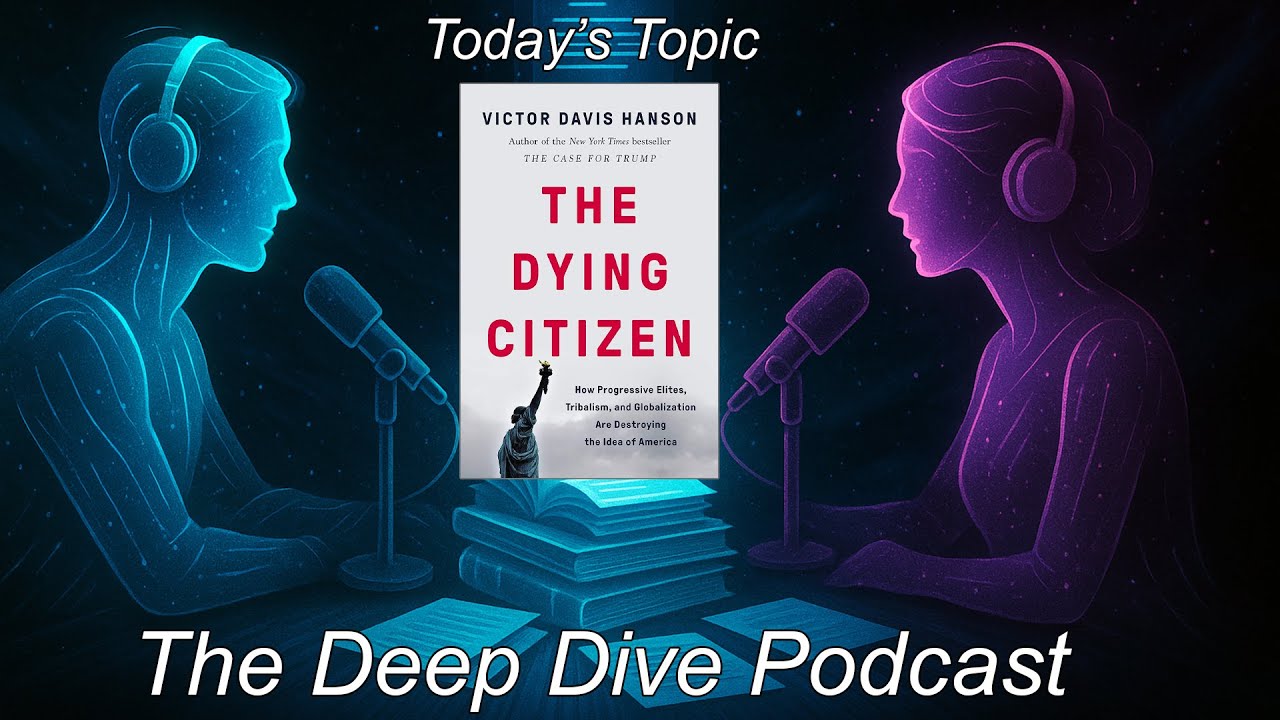

The Dying Citizen: How the Middle Class, the Constitution, and the Idea of America Are Unraveling

You May Also Like…

The Myth of the Robber Barons: A New Look at the Rise of Big Business in America

The Myth of the Robber Barons: A New Look at the Rise of Big Business in America

The Myth of the Robber Barons dismantles the long-held narrative that America’s Gilded Age titans like Vanderbilt, Rockefeller, and Carnegie were ruthless villains exploiting workers and crushing competition. Historian Burton Folsom distinguishes between “market entrepreneurs,” who innovated to lower prices and create value (e.g., Vanderbilt slashing steamship fares by 90% through efficiency), and “political entrepreneurs,” who relied on government subsidies and failed spectacularly (e.g., Collins’ subsidized lines collapsing). Market giants like James J. Hill built superior railroads without handouts, outlasting wasteful, corrupt subsidized rivals, while Carnegie and Rockefeller revolutionized steel and oil by focusing on quality and cost-cutting. Folsom argues true capitalism thrives on voluntary cooperation and consumer service, not cronyism, where political favors breed inefficiency and higher costs for all. This distinction reveals how the “robber baron” label smears innovators while ignoring real parasites using state power. The book warns that today’s crony capitalism echoes those failures, urging a return to free-market principles for genuine progress. Provocative and eye-opening, it challenges: in an era of bailouts and regulations, are we rewarding true creators or just modern political entrepreneurs?

Discourse Concerning Government: The Ideas That Helped Inspire the Declaration of Independence

Discourse Concerning Government: The Ideas That Helped Inspire the Declaration of Independence

Discourses Concerning Government (1698) by Algernon Sidney, executed for treason in 1683 with his manuscript as evidence, serves as a fiery blueprint for republican liberty that profoundly influenced America’s Founders like Jefferson. Sidney argues that all political power originates from the people, who form governments through voluntary consent to protect natural rights, rejecting divine-right monarchy as tyrannical idolatry. He champions self-governance rooted in virtue, reason, and law, warning that corrupt rulers breed servility while a vigilant, educated citizenry sustains freedom. Drawing from classical thinkers like Aristotle and Cicero, Sidney asserts unjust laws are void, and resistance to tyranny is a moral duty, equating absolute power with slavery. His work, smuggled and published posthumously, directly shaped the Declaration of Independence’s emphasis on consent, equality, and the right to revolt. This defiant treatise challenges listeners: if liberty demands constant virtue and vigilance from citizens, are we upholding Sidney’s principles today, or allowing corruption to erode our self-rule? A riveting exploration of the intellectual roots that birthed modern democracy—essential listening for understanding freedom’s fragile foundations.

The Myth of Left and Right: How the Political Spectrum Misleads and Harms America

The Myth of Left and Right: How the Political Spectrum Misleads and Harms America

The Myth of Left and Right explodes the idea that “left” and “right” represent coherent worldviews, arguing instead that they’re mere tribal uniforms—social groups bound by identity, not fixed philosophical essences. Authors Hyrum and Verlan Lewis dismantle the “essentialist myth,” showing how policy positions flip-flop (e.g., Republicans abandoning free trade, Democrats embracing military intervention) not due to evolution but tribal loyalty to leaders. This illusion fuels affective polarization, turning debates into good-vs-evil battles that justify extremism, as seen in events like January 6th. The spectrum misleads by implying logical consistency where none exists, harming discourse and enabling manipulation. True progress requires ditching ideological certainty for humility, rationalism, and local community-building over national tribalism. The book warns that this myth erodes truth and freedom, urging a shift from principled fanaticism to error-correcting accuracy. This eye-opening critique leaves listeners asking: Are you ready to prioritize intellectual humility over your political tribe’s comforting illusions?