Murray Rothbard’s analysis traces money’s origins from barter’s limitations, where indivisibility and lack of coincident wants necessitated marketable commodities like gold and silver as natural mediums of exchange, enabling specialization and prosperity through voluntary trade. Governments, seeking revenue and control, corrupted this system by monopolizing mints, debasing coins, imposing legal tender laws, and establishing central banks to inflate currency covertly, acting as a hidden tax that distorts economies and erodes savings. Historical phases evolved from commodity standards to gold exchanges, bimetallism fiascos, and Bretton Woods’ collapse in 1971, leading to today’s unanchored fiat system prone to sustained inflation and instability. Rothbard advocates for market-driven sound money to protect property rights and liberty, challenging the assumption that government must control currency when free markets efficiently produce other goods.

Greg Stuessel
The Politics of Obedience: Why We Serve Power and Forget the Freedom We Were Born With
Étienne de La Boétie’s 16th-century Discourse on Voluntary Servitude exposes the paradox of tyranny, arguing that rulers hold power not through inherent strength but through the people’s willing consent, rooted in habit, fear, and engineered dependency. He posits liberty as humanity’s natural state, eroded by custom that normalizes servitude and a hierarchy of privileges that co-opts elites to sustain the tyrant’s control. La Boétie urges intellectual resistance through education and reason to break the cycle, revealing how tyrants suppress knowledge, divide subjects, and use spectacle to maintain obedience. Ultimately, withdrawing collective consent could dismantle oppression, as freedom requires only the courage to reject voluntary servitude and reclaim natural equality.
The Dying Citizen: How the Middle Class, the Constitution, and the Idea of America Are Unraveling
Victor Davis Hanson’s The Dying Citizen warns that the rare, hard-won ideal of self-governing citizenship—evolving over 2,500 years from Greek city-states to modern America—is eroding under six intertwined threats: economic dependency turning middle-class producers into “peasants,” cultural divisions fostering tribalism over civic unity, and porous borders diluting national identity. From the top, unelected bureaucrats in the “deep state” wield unchecked power, revolutionary ideologies seek to dismantle traditional values, and global elites prioritize transnational agendas that subordinate sovereignty to unaccountable bodies. Hanson highlights 2020’s chaos—pandemic lockdowns, riots, and economic upheaval, as an accelerator, reversing gains in middle-class independence and amplifying identity politics while big tech censors free speech. This deep dive urges reclaiming economic autonomy, shared culture, and constitutional protections to revive the autonomous citizen, posing a stark question: who truly benefits from the middle class’s decline amid elite wealth surges?
The Great Debate: How Fear and Freedom Collided in the Ratification of the Constitution (1787–1788)
In 1787-1788, the U.S. Constitution faced a fierce, nationwide debate that nearly derailed its adoption, transforming from a Philadelphia compromise into a public battle over federal power, states’ rights, and the absence of a Bill of Rights, as detailed in Pauline Maier’s Ratification. Triggered by crises like Shays’ Rebellion and the Articles of Confederation’s weaknesses, Federalists pushed for a stronger union while Anti-Federalists warned of centralized tyranny, with media bias favoring supporters but pamphlets like those from “Brutus” amplifying opposition. Key states saw dramatic contests: Pennsylvania’s violent ratification, Massachusetts’ amendment compromise, Virginia’s close vote amid Patrick Henry’s oratory, and New York’s holdout risking isolation until external pressures forced approval. Ultimately, the messy process secured the Constitution, guaranteed the Bill of Rights through promised amendments, and established popular sovereignty as the foundation of American legitimacy, with Anti-Federalist ideas echoing in later reforms.
An Essay on the Trial by Jury: Lysander Spooner’s Defense of the People’s Right to Judge the Law
What if a jury’s true purpose is not merely to decide guilt, but to protect liberty itself? In this episode of The Deep Dive, we explore Lysander Spooner’s argument that juries were meant to judge not only facts, but the justice of the law itself, serving as the people’s final safeguard against tyranny. Drawing on An Essay on the Trial by Jury (1852) and the principles of Magna Carta, Spooner warned that when jurors surrender their judgment to judges and statutes, trials become instruments of government power rather than justice by the people. The Founders understood the jury as a moral conscience of the community, a peaceful means of resisting injustice without revolution. Pour a cup of coffee and listen as we rediscover what Spooner called “trial by the country,” and what freedom was meant to sound like.
Natural Law: The Forgotten Foundation of Freedom and the Moral Order of Civilization
What if the key to justice, rights, and human dignity wasn’t invented—but discovered? The Essential Natural Law takes you on a fast-paced journey through one of the oldest and most powerful ideas in Western civilization: that there’s a moral order woven into the fabric of reality, and we can know it through reason. From ancient philosophers to modern-day thinkers, this book uncovers how natural law has shaped law, liberty, and human flourishing—and why ignoring it may be the biggest mistake modern society is making. If you’re tired of moral relativism and want to understand the roots of real justice, this is the intellectual ammo you’ve been waiting for.
Judicial Monarchs: How the Courts Rewrote the American Constitution
What happens when unelected judges become the real rulers of a republic? In this hard-hitting episode of The Deep Dive, we sink our teeth into Judicial Monarchs by William Watkins Jr.—a scathing takedown of America’s activist judiciary and its quiet transformation into an unaccountable ruling class. Watkins argues that the courts have hijacked the Constitution, replacing popular sovereignty with sweeping legal mandates handed down from on high. With landmark cases, historical flashpoints, and sharp constitutional analysis, this book isn’t just a warning—it’s a fire alarm. If you’ve ever wondered how five black robes can reshape your rights, your laws, and your country, don’t miss this explosive conversation.
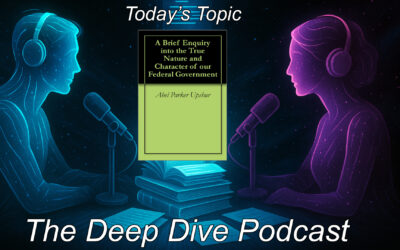
Brief Enquiry into the True Nature and Character of Our Federal Government: The Forgotten Truth
What if everything you were taught about the U.S. Constitution was wrong? This Deep Dive into Abel Upshur’s bold and provocative 1840 work dismantles the nationalist narrative of America’s founding and delivers a searing defense of states’ rights and local sovereignty. With razor-sharp logic and unapologetic conviction, Upshur argues that the Union was never intended as a centralized empire, but rather a compact among sovereign states, each retaining its original authority. Long forgotten but increasingly rediscovered by those challenging modern federal overreach, A Brief Enquiry is essential reading for anyone questioning the true character of American government and seeking the intellectual ammunition to do so.
Fraternal Societies, Mutual Aid, and the Welfare State: America’s Original Safety Net
In the late 19th and early 20th centuries, fraternal societies in America formed a vast voluntary safety net, providing millions of working-class members with sickness benefits, life insurance, health care, and community support through principles of reciprocity and self-reliance rather than charity, empowering diverse groups including immigrants, Black Americans, and women with institutions like banks, hospitals, and retirement homes. Black-led orders such as the United Order of True Reformers and the Independent Order of St. Luke exemplified economic defiance against exclusion, while women’s lodges promoted financial literacy and leadership, all rooted in Tocqueville’s vision of American associational life. However, medical societies’ boycotts dismantled affordable lodge doctor systems, and the 1930s rise of compulsory government welfare like Social Security reduced the necessity for these networks, raising questions about whether centralized programs eroded civic habits of self-governance and community responsibility essential to liberty.
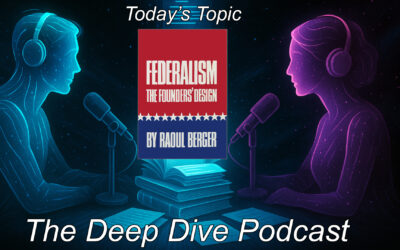
Federalism – The Founders’ Design: How Washington & Courts Centralized Power Originally Divided
In this episode of The Deep Dive Podcast, Raoul Berger’s Federalism: The Founders’ Design guides an exploration of the U.S. Constitution as a compact among sovereign states, delegating limited external powers to a federal agent while reserving vast internal authority to states for protecting liberty. The founders rejected vague grants of power, opting for enumerated federal roles like commerce regulation to prevent state trade wars, and safeguards such as the 10th Amendment to maintain dual sovereignty and inviolable state police powers over education, property, and health. Clauses like necessary and proper, supremacy, and general welfare were interpreted narrowly during ratification to support only specified ends, not boundless expansion. However, judicial interpretations have eroded this balance, using concepts like economic integration to justify federal overreach into local affairs, bypassing the amendment process. Ultimately, the podcast challenges listeners to consider mechanisms for states to reclaim sovereignty and vigilance against centralized power, echoing warnings from Madison and Washington about usurpation threatening free government.