
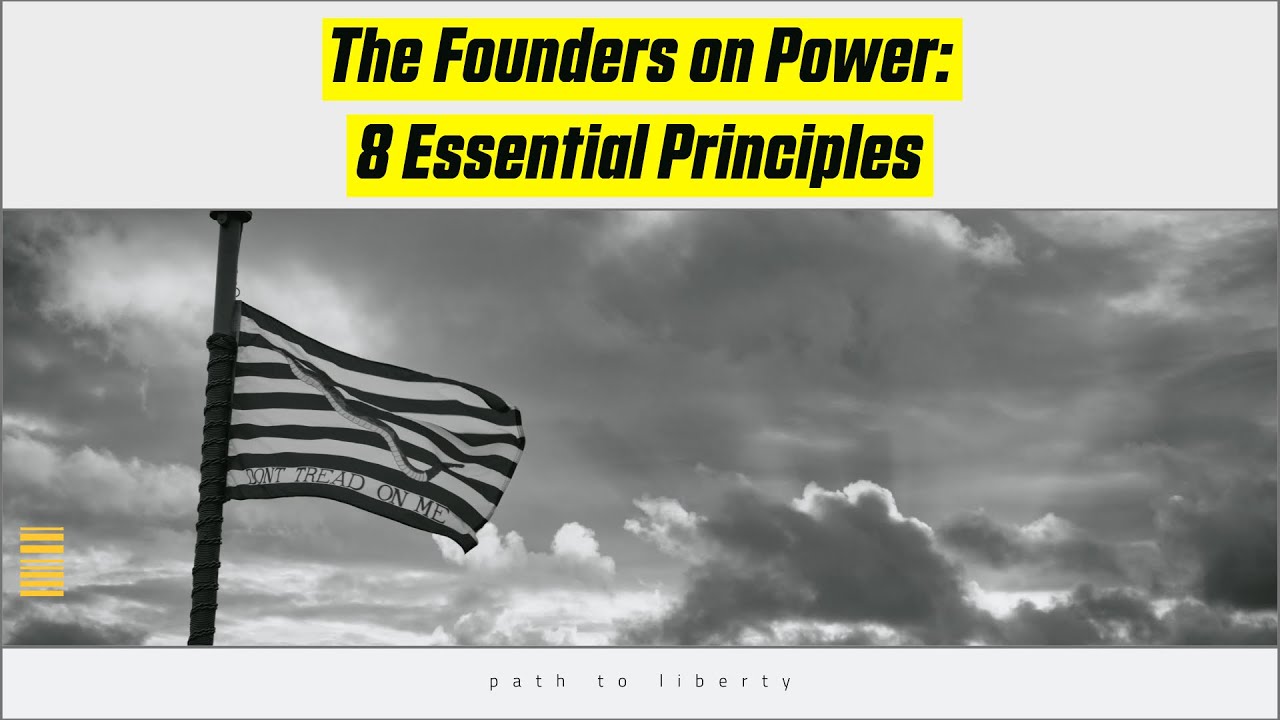
![Foundational Principles of Power: Insights from the Founders [VIDEO]](https://i0.wp.com/blog.tenthamendmentcenter.com/files/2024/06/path-061424-1024x576.jpeg?w=1024&resize=1024,576&ssl=1 "Foundational Principles of Power: Insights from the Founders [VIDEO]")
Understanding the nature of power and its limits is essential to achieving true freedom. The Founders of the United States recognized this necessity, emphasizing that unchecked power equates to tyranny. In this article, we will explore eight foundational principles from the Founders on power to help guide us towards liberty.
Principle 1: Power Derives from the People
George Mason, in the Virginia Declaration of Rights, stated that “all power is vested in, and consequently derived from, the people.” This means that those in power are merely trustees and servants of the people, accountable to them at all times. Robert Livingston echoed this sentiment, reinforcing that all power originates from the populace.
Principle 2: Power Must Have Defined Limits
The Founders believed that liberties are safest when power is limited. Richard Henry Lee articulated this in a letter to Patrick Henry, stressing that liberty is not secure under a benevolent government but through strict limitations of power. The Maryland Farmer, writing in March 1788, broadened this notion by stating that any human authority must have confined limits to prevent insolence and oppression.
Principle 3: Power Not Given is Retained
George Nicholas highlighted a universally agreed principle that powers not explicitly given are retained by the people. Edmund Randolph reiterated this during the Virginia ratifying convention, noting that all authority not given to the government remains with the people and can be reclaimed if abused.
Principle 4: Power Always Seeks to Grow
The maxim “power corrupts, and absolute power corrupts absolutely” underscores the Founders’ understanding that power, once given, tends to expand. Abigail Adams observed that power is ever grasping, never satisfied. The Federal Farmer warned that those in power will interpret laws in ways that increase their authority.
Principle 5: Arbitrary Power is Tyranny
Arbitrary power, or power exercised without right or authority, was defined by the Founders as tyranny. Thomas Paine asserted that all delegated power is a trust, and any assumed power is usurpation. John Locke, in his writings on tyranny, noted that power used to oppress rather than protect the people becomes tyranny.
Principle 6: The Power to Do Good is Also the Power to Do Evil
Power, even when used for good, holds the potential for evil. The first Chief Justice, John Jay, cautioned that the power to do good implies the power to do harm. Oliver Ellsworth, the third Chief Justice, similarly noted that the ability to do good always includes the potential for evil if those in power are so inclined.
Principle 7: Centralization of Power Leads to Despotism
The Founders warned that consolidating power into one body results in tyranny. Patrick Henry stated that consolidation would destroy liberties. Thomas Jefferson, reflecting on history, observed that the generalizing and concentrating of power has destroyed liberty in every government that has ever existed.
Principle 8: Power Does Not Limit Itself
The final principle emphasizes that power does not inherently impose limits on itself. Thomas Jefferson, in the Kentucky Resolutions of 1798, argued that allowing those in power to define the extent of their own authority leads to unlimited submission to the government. Therefore, it is crucial to have external checks on power to ensure it remains limited.
Conclusion
The Founders provided us with a roadmap to liberty, centered on the understanding and limitation of power. To preserve freedom, we must remain vigilant and ensure that power remains derived from and accountable to the people, with strict limits to prevent its growth and abuse. These principles serve as a guide to maintaining a government that truly serves its people, protecting their liberties rather than oppressing them.
For further exploration of these principles and the work of the 10th Amendment Center, visit their website and consider supporting their efforts to defend constitutional liberty.
![Dr. Joseph Warren: Pro-Liberty and Anti-Empire Leader of the Sons of Liberty [VIDEO]](https://wp.fifu.app/smellthefreedom.org/aHR0cHM6Ly9pLnl0aW1nLmNvbS92aS9Kd0VEUXhnZzlQby9tYXhyZXNkZWZhdWx0LmpwZw/ee04c626bd48/dr-joseph-warren-pro-liberty-and-anti-empire-leader-of-the-sons-of-liberty-video.webp?w=400&h=250&c=1&p=258382 "Dr. Joseph Warren: Pro-Liberty and Anti-Empire Leader of the Sons of Liberty [VIDEO]")