
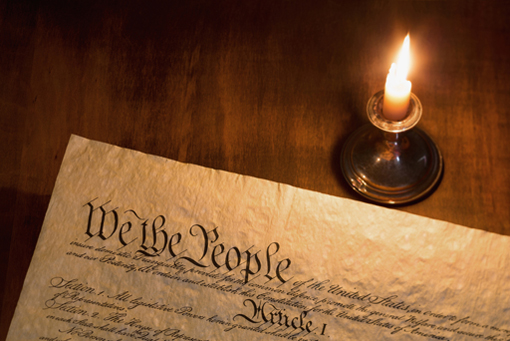
For years, the prevailing teachings in government-run schools have often emphasized the supremacy of laws passed by the government. However, it’s essential to understand that it is the Constitution that holds supreme authority, not merely any laws that the government decides to enact. This principle stems from the founders’ intent, highlighting that the government does not have the ultimate say over the extent of its own powers. Anything beyond the Constitution was considered a usurpation or theft of power by the founders.
The Concept of “Void” in Constitutional Context
From the beginning of the American Revolution through the ratification of the Constitution and beyond, the founders had a specific term for laws that exceeded constitutional bounds: void. This term signifies that any law passed outside the Constitution’s framework is null and void from the moment it is enacted. This idea is crucial to understanding the limitations placed on governmental power by the Constitution.
Historical Perspectives on Constitutional Limits
James Otis Jr. famously argued against the writs of assistance in 1761, declaring that “an act against the Constitution is void.” This viewpoint was not isolated but echoed throughout the early American revolutionary period. For instance, a memorial from a Boston town meeting in 1764 asserted that the authority of the British Parliament was circumscribed by certain bounds, and any acts exceeding these were mere power without right, and consequently, void.
Patrick Henry, in his resolves against the Stamp Act of 1765, also emphasized that only the local assembly had the right to impose taxes, and any attempt to vest such power elsewhere was unconstitutional and void. Similarly, Samuel Adams, writing in the Boston Gazette in 1772, argued that any act of Parliament made against the fundamental laws and liberties of the people, as declared in Magna Carta, was void.
Even Alexander Hamilton, in his earlier writings like “The Farmer Refuted” in 1775, argued that laws contradicting the essential rights of society were null and void. Although Hamilton later supported a stronger federal government, his early arguments reflected the revolutionary sentiment against unlimited governmental power.
Constitutional Supremacy and Limited Government
The supremacy clause of the Constitution establishes that the Constitution and laws made in pursuance of it are the supreme law of the land. This clause was meant to strike a balance, giving the federal government authority only in specific, enumerated areas. As James Madison noted in Federalist No. 45, the powers delegated to the federal government are “few and defined.”
St. George Tucker, an early constitutional commentator, reinforced this by stating that laws limited to objects authorized by the Constitution would be the supreme law of the land, but those beyond it would be acts of usurpation and consequently void.
Enforcement and Final Authority
The question of who decides the extent of governmental powers under the Constitution is pivotal. Founders like Thomas Jefferson and James Madison argued that it is not the federal government that has the final say over its powers. Jefferson, in the Kentucky Resolutions of 1798, stated that acts beyond delegated powers are unauthoritative, void, and of no force. Madison, in his report of 1800, reiterated that the states, in their sovereign capacity, have the final authority to decide on the constitutionality of federal actions.
The Role of the People
Ultimately, the founders believed that the people, through their states, held the final say in determining the extent of governmental powers. This principle aimed to prevent the rise of arbitrary and unlimited government power, ensuring that sovereignty remained with the people. As Alexander Hamilton stated in Federalist No. 78, “no legislative act contrary to the Constitution can be valid,” reinforcing the idea that the Constitution is the ultimate measure of governmental power.
Conclusion
Understanding the supremacy of the Constitution is crucial for maintaining the balance of power in the United States. The founders’ intent was clear: any act outside the bounds of the Constitution is void, and the ultimate authority lies with the people. This principle is foundational to American liberty and the proper functioning of a limited government. To delve deeper into this topic and related historical documents, visit the Tenth Amendment Center’s resources and educational materials.
For further exploration and to support the ongoing education on these principles, consider joining the Tenth Amendment Center. Your support helps promote a deeper understanding of the Constitution and its vital role in safeguarding liberty.
![Understanding the Second Amendment: Eight Essential Principles [VIDEO]](https://wp.fifu.app/smellthefreedom.org/aHR0cHM6Ly9pLnl0aW1nLmNvbS92aS9pWnUyN005a3pTTS9tYXhyZXNkZWZhdWx0LmpwZw/14705cfc436c/understanding-the-second-amendment-eight-essential-principles-video.webp?w=400&h=250&c=1&p=258444 "Understanding the Second Amendment: Eight Essential Principles [VIDEO]")
![A DIY Guide to Understanding the Original Meaning of the U.S. Constitution [VIDEO]](https://wp.fifu.app/smellthefreedom.org/aHR0cHM6Ly9pLnl0aW1nLmNvbS92aS9xaGYtU1FkcDk0QS9tYXhyZXNkZWZhdWx0LmpwZw/d458ce77a520/a-diy-guide-to-understanding-the-original-meaning-of-the-u-s-constitution-video.webp?w=400&h=250&c=1&p=258439 "A DIY Guide to Understanding the Original Meaning of the U.S. Constitution [VIDEO]")
![The Anti-Federalist Concerns: Was the Constitution a Blueprint for Tyranny? [VIDEO]](https://wp.fifu.app/smellthefreedom.org/aHR0cHM6Ly9pLnl0aW1nLmNvbS92aS9OTTN4SGNNd0Nyay9tYXhyZXNkZWZhdWx0LmpwZw/c210deb6864f/the-anti-federalist-concerns-was-the-constitution-a-blueprint-for-tyranny-video.webp?w=400&h=250&c=1&p=258437 "The Anti-Federalist Concerns: Was the Constitution a Blueprint for Tyranny? [VIDEO]")